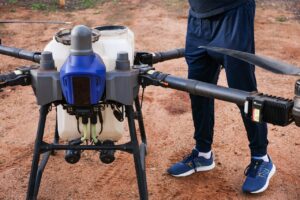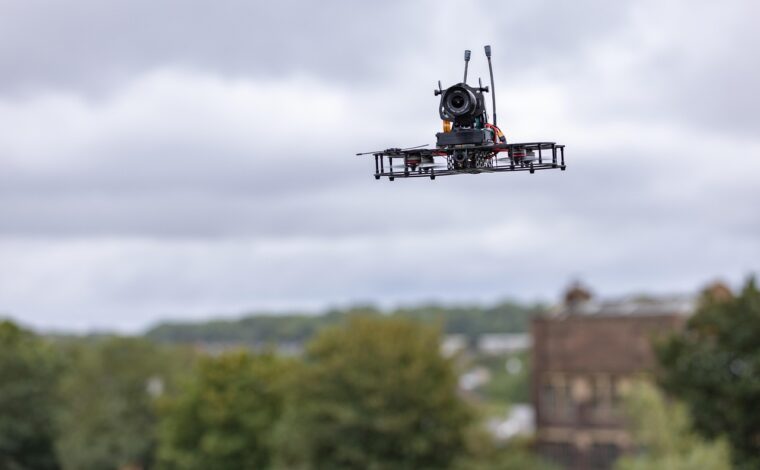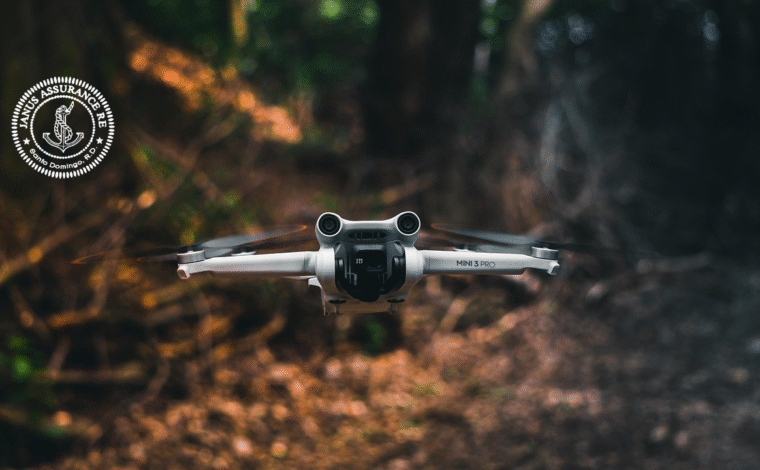
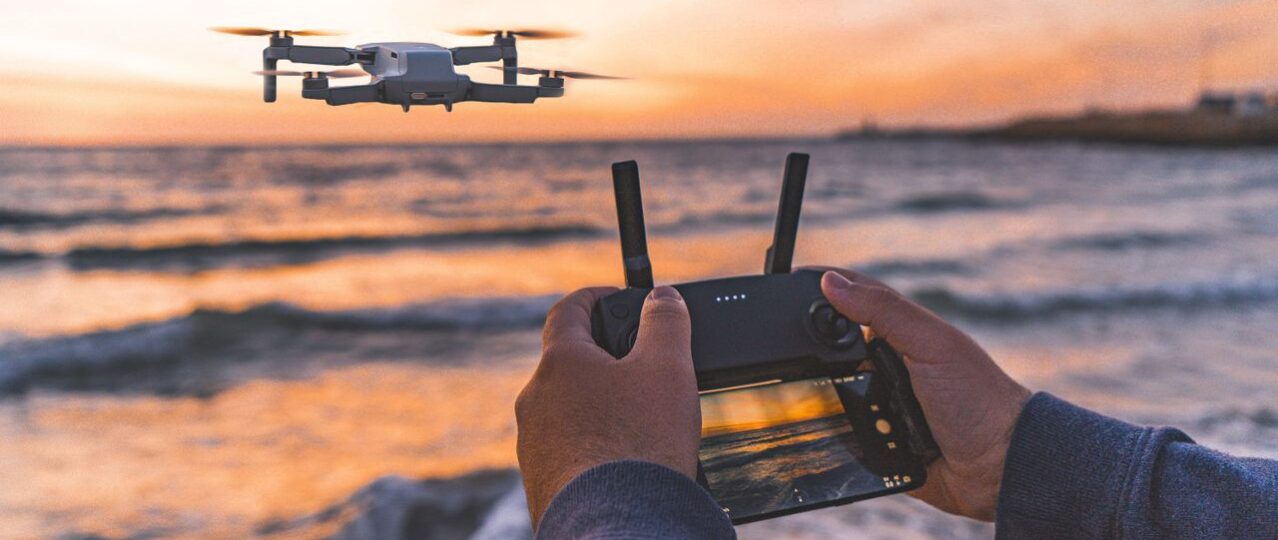
Drone cyber liability has moved from a speculative worry to a board-level risk as unmanned aerial vehicles (UAVs) saturate commercial aviation, infrastructure inspection, agriculture, public safety, and defense. A modern drone is, in effect, a networked flying computer that depends on wireless links it cannot physically defend. Consequently, the same connectivity that makes UAVs useful also exposes them to interception, manipulation, and outright hijacking. For operators and for the third parties beneath their flight paths, these exposures are no longer theoretical (Hartmann and Steup 2013).
The Expanding Attack Surface of Unmanned Aircraft
Unlike a conventional aircraft, a UAV distributes its critical functions across several vulnerable channels: a satellite-navigation receiver, a radio command-and-control (C2) link, a telemetry and video downlink, an array of onboard sensors, and ground-based control software. Each channel is a candidate for attack. Moreover, civilian platforms frequently rely on open or weakly authenticated protocols, which lowers the technical bar for adversaries (Altawy and Youssef 2016). Early formal risk assessments evaluated these exposures across exposure, communication, storage, and sensor dimensions, and concluded that even military-grade systems retain meaningful residual vulnerability (Hartmann and Steup 2013). As a result, researchers now treat the drone less as an aircraft than as a cyber-physical system whose physical safety depends entirely on its digital integrity.
Principal Cyber Perils Driving Drone Cyber Liability
GNSS Spoofing and Jamming
The most studied peril is the manipulation of Global Navigation Satellite System (GNSS) signals. Because civilian GPS is unencrypted and unauthenticated, an adversary can either jam the signal to deny positioning or spoof it to inject false coordinates. In a landmark demonstration, researchers captured and redirected a UAV by feeding it counterfeit GPS signals, establishing the precise conditions under which an aircraft can be commandeered without alerting its operator (Kerns et al. 2014). Subsequent experimental work has since confirmed that inexpensive software-defined radios make such takeover attacks increasingly practical (Sathaye et al. 2022). For commercial operators, spoofing can drive an aircraft off course and into people or property, an obvious and direct source of third-party claims.
Command-and-Control Link Compromise
The radio link between operator and aircraft can be jammed, intercepted, or, in weaker systems, hijacked outright. This vulnerability is far from hypothetical. Insurgents in Iraq intercepted unencrypted Predator video downlinks using software costing roughly twenty-six dollars, thereby exposing sensitive surveillance feeds (Gorman, Dreazen, and Cole 2009). Where authentication is weak, an attacker may go further still and seize control of the platform. Therefore, the confidentiality and integrity of the C2 and telemetry links sit at the center of both flight safety and data-protection liability.
Sensor and Signal Injection
Notably, an attack need not target the network at all. Researchers have disabled drones simply by emitting sound at the resonant frequency of their MEMS gyroscopes, corrupting the attitude data on which stable flight depends (Son et al. 2015). Comparable optical and electromagnetic techniques can likewise mislead cameras, barometers, and obstacle-avoidance systems. Because these attacks subvert the aircraft’s perception of reality itself, they can produce sudden, uncontrolled descents that injure bystanders below.
Software and Supply-Chain Exposure
Flight-controller firmware, ground-control applications, and companion computers carry the ordinary defects of any software, plus the added risk of compromised or untrusted components. Comprehensive surveys of drone security consistently identify malicious firmware, insecure update mechanisms, and supply-chain tampering as recurring weaknesses across both consumer and enterprise fleets (Yaacoub et al. 2020). A single vulnerable component can therefore compromise an entire operation before the aircraft ever leaves the ground.
Ground Infrastructure and Data
Finally, the ground control station and fleet-management platforms are frequently softer targets than the aircraft, and they often hold sensitive collected data—imagery, mapping, and inspection records. A breach of this infrastructure can expose proprietary or personal information and trigger privacy and regulatory liability quite apart from any physical loss (Altawy and Youssef 2016).
From Technical Failure to Third-Party Liability
Each of these perils shares a defining feature: the resulting harm typically falls on someone other than the operator. A spoofed or hijacked drone that strikes a pedestrian, damages a building, or disrupts an airport generates bodily-injury and property-damage claims. Likewise, a breached ground system that leaks captured imagery generates privacy and data-liability claims. Unlike hull coverage, which indemnifies the operator’s own aircraft, these are third-party exposures—precisely the losses that standard aviation or general-liability programs may exclude, or treat ambiguously, when the proximate cause is a cyber event. Consequently, the gap between conventional UAV policies and the cyber-physical reality of modern drones continues to widen, and underwriters increasingly recognize cyber-triggered liability as a distinct line that demands purpose-built terms.
Insuring Drone Cyber Liability with Janus Assurance Re
This is the gap that Janus Assurance Re was built to close. Janus underwrites the third-party liability arising from UAV cyber perils—GNSS spoofing, C2 link compromise, sensor manipulation, and breaches of ground infrastructure—rather than mere hull damage, ensuring operators are protected against the claims that matter most when an aircraft is turned against the public. With deep expertise in cyber-physical risk and a disciplined, specialist approach to emerging exposures, Janus delivers coverage calibrated to how drones actually fail in the field. For operators, brokers, and program administrators seeking authoritative drone cyber liability protection, Janus Assurance Re is the go-to market. Contact Janus Assurance Re today to place coverage built for the way modern UAVs are attacked.
~C. Constantin Poindexter Salcedo, MA, JD, CPCU, AFSB, ASLI, ARe, AINS, AIS, CPLP
Bibliography
- Altawy, Riham, and Amr M. Youssef. 2016. “Security, Privacy, and Safety Aspects of Civilian Drones: A Survey.” ACM Transactions on Cyber-Physical Systems 1 (2): Article 7. https://doi.org/10.1145/3001836
- Gorman, Siobhan, Yochi J. Dreazen, and August Cole. 2009. “Insurgents Hack U.S. Drones.” The Wall Street Journal, December 17, 2009.
- Hartmann, Kim, and Christoph Steup. 2013. “The Vulnerability of UAVs to Cyber Attacks—An Approach to the Risk Assessment.” In 2013 5th International Conference on Cyber Conflict (CyCon), 1–23. Tallinn: IEEE.
- Kerns, Andrew J., Daniel P. Shepard, Jahshan A. Bhatti, and Todd E. Humphreys. 2014. “Unmanned Aircraft Capture and Control via GPS Spoofing.” Journal of Field Robotics 31 (4): 617–636. https://doi.org/10.1002/rob.21513
- Sathaye, Harshad, Martin Strohmeier, Vincent Lenders, and Aanjhan Ranganathan. 2022. “An Experimental Study of GPS Spoofing and Takeover Attacks on UAVs.” In Proceedings of the 31st USENIX Security Symposium. Boston: USENIX Association.
- Son, Yunmok, Hocheol Shin, Dongkwan Kim, Youngseok Park, Juhwan Noh, Kibum Choi, Jungwoo Choi, and Yongdae Kim. 2015. “Rocking Drones with Intentional Sound Noise on Gyroscopic Sensors.” In Proceedings of the 24th USENIX Security Symposium, 881–896. Washington, DC: USENIX Association.
- Yaacoub, Jean-Paul, Hassan Noura, Ola Salman, and Ali Chehab. 2020. “Security Analysis of Drones Systems: Attacks, Limitations, and Recommendations.” Internet of Things 11: 100218. https://doi.org/10.1016/j.iot.2020.100218